
A National Organizer Speaks
by Elliot Oppenheim |MPhil Student in American History at the University of Cambridge; Workers Circle College Network member
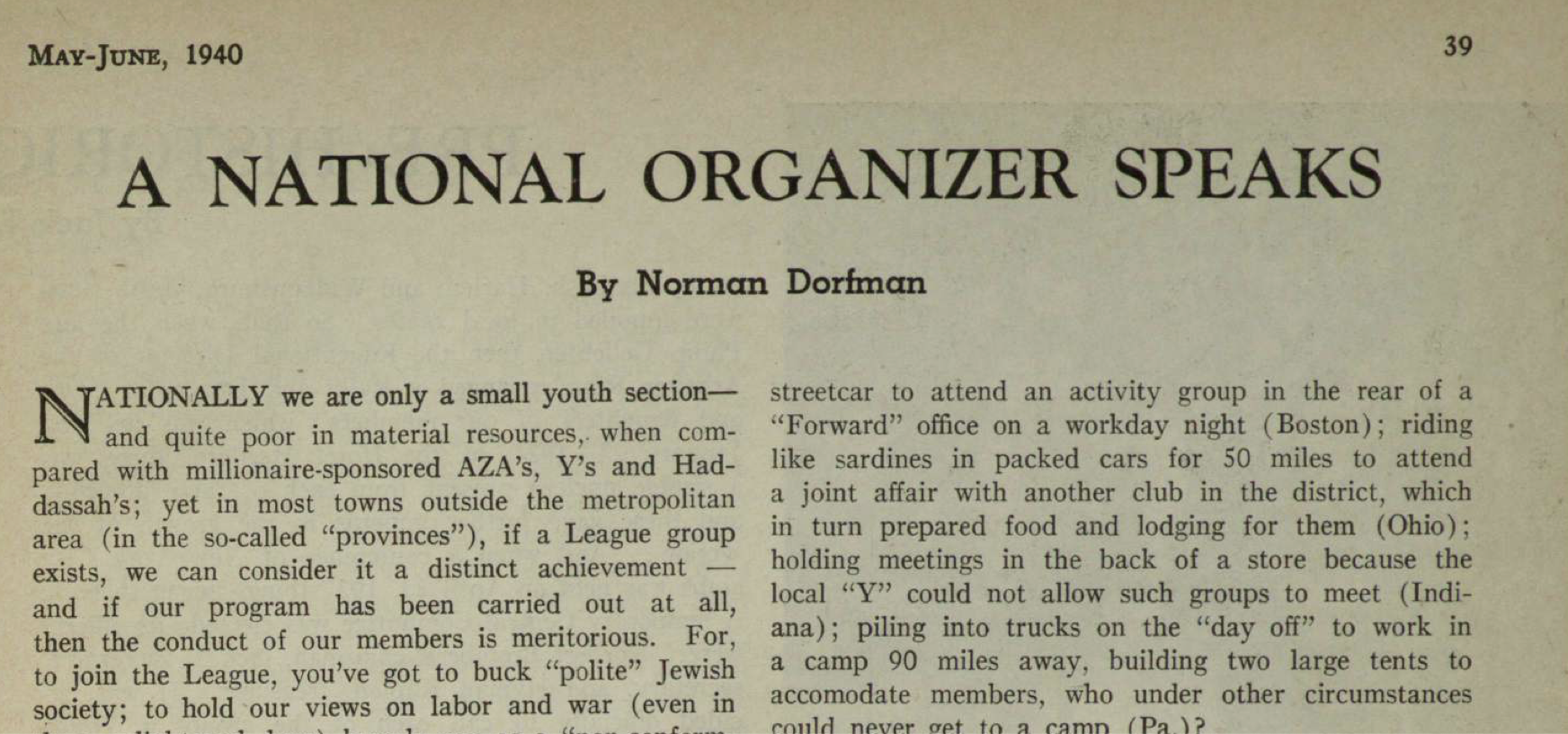
As the Workers Circle places renewed emphasis on engaging young people in its programming, it is worth remembering that youth organizing has long been central to the organization’s mission. Writing in The Call in 1940, former Young Circle League of America (YCLA) Assistant Director and New York Organizer Norman Dorfman reflected on the first decade of the Workmen’s Circle’s youth movement and the unlikely places it took root, particularly in the American South.
Dorfman’s article, “A National Organizer Speaks,” was published ten years after the Workmen’s Circle established a section specifically for youth: the YCLA. While the Workmen’s Circle had long run kindershules, the League was unique in centering youth leadership. This change created space for young members to establish their own vision of secular Jewish life. Dorfman argues that this vision remained consistent with the values of the adult organization while adapting to the needs and interests of younger members, particularly by operating in English.
The League was also more explicitly political than much of the Workmen’s Circle’s earlier youth programming. Belonging to a Young Circle club meant embracing a set of values that often set members apart from their peers. Dorfman writes:
For, to join the League, you've got to buck “polite” Jewish society; to hold our views on labor and war (even in these enlightened days) brands you as a “non-conformist”; to keep up your association after being politely criticized may mean losing some of your friends.¹
One of the most striking examples Dorfman highlights is the work of the Atlanta chapter. Home to the first Young Circle League chapter in the region, Atlanta soon became a hub for the Workmen’s Circle’s efforts to reach Southern youth. From an initial group of just fifteen members, the Atlanta branch quickly expanded its reach, helping establish chapters in Birmingham, Memphis, Nashville, and Chattanooga within a year, forming the core of the League’s Southeastern district.
Members of these Southern chapters often traveled hundreds of miles and “faced a hostile press and moral code” in order to organize events and activities. Their work included sponsoring lectures by the League for Industrial Democracy, a national organization devoted to promoting democratic socialism and labor reform. These gatherings connected Jewish youth to broader debates about labor rights, economic inequality, and the future of democracy in the United States.
In the segregated South of the 1930s, these activities carried significant racial implications. Dorfman writes that Atlanta’s youth activists hosted League for Industrial Democracy lectures that brought “under one roof for the first time a mixed white and colored audience.” In Jim Crow Atlanta, such gatherings were unusual and reflected a largely theoretical commitment among many Jewish labor activists to interracial cooperation within the labor movement. This was particularly notable given that openly interracial organizing was uncommon among most Southern Jewish institutions, including many of the Workmen’s Circle’s adult chapters in the region.²
Young Circleites also supported labor struggles that were deeply controversial in the region. According to Dorfman, YCLA members backed the Textile Workers during their 1934 strike and assisted organizing efforts by the International Ladies’ Garment Workers’ Union. These efforts were part of a national wave of labor activism during the Great Depression, including the expansion of labor organizing across the U.S. South. Nevertheless, labor organizing in the Depression-era South required a willingness to challenge both local political norms and expectations within the Jewish community. These efforts reflected the broader culture of Jewish labor radicalism that shaped the Workmen’s Circle in the early twentieth century and highlighted the ways young activists carried those traditions forward.
Despite Dorfman’s long list of the young organizers’ accomplishments, his article is not only celebratory. He repeatedly reflects on how much more might have been possible with greater institutional support. Young organizers often traveled long distances to attend meetings, held events in borrowed or improvised spaces, and relied heavily on volunteer labor. In the article, Dorfman wonders how much further the movement might have expanded if the Workmen’s Circle had invested more heavily in youth centers, full-time organizers, and educational programming.
Dorfman concludes his reflection by praising the resilience of these young activists, whom he describes as “tempered by hardship.” YCLA members’ commitment to the ideals of the Workmen’s Circle, and their willingness to explore and create new ways to engage those ideals, guided them in building a movement that sometimes set them apart from both their peers and their parents.
Eighty years later, as the Workers Circle once again seeks to engage new generations, Dorfman’s reflections serve as a reminder that youth organizing has long been central to the organization’s vision and that a vibrant youth movement often requires space for new politics, new ideas, and new voices.
¹ Norman Dorfman, "A National Organizer Speaks," May 1940, https://www.archive.thecall.org/?a=d&d=WCC194005-01.2.34
² Joshua Parshall, “Yiddish Politics in Southern States: The Southern District of the Arbeter Ring, 1908-1949,” https://cdr.lib.unc.edu/concern/dissertations/qr46r208w?locale=en